Local elections analysis: Labour struggled more versus the Greens than Reform
Locals give fresh evidence on how the 2024 Labour coalition is breaking apart

As with every set of English local elections, there are a huge number of different results to pick through and stories to pick out. Many takes are available, here comes another.
This year’s set of locals included many of the country’s biggest cities, including London, Manchester, Birmingham, Sheffield, and Leeds. It also included districts centred on many leave-voting towns and smaller cities up and down the north and midlands, and some county councils in the south and east.
Most of them were, until now, predominantly Labour held, and (mostly) last contested in 2022. That year’s elections were altogether pretty rosy for Labour - they did not feature surging Reform UK or Green parties, and were followed shortly by the resignation of the deeply unpopular Boris Johnson as prime minister. In that sense, Labour were defending a set of results from what was widely agreed to be a pretty high baseline.
In the context of what will turn out to be around 1500 Labour losses against that baseline - or put another way, a ‘loss rate’ of around 60% of seats defended - I am going to use this post to focus on one important angle: what the locals can tell us about the fragmentation of Labour’s 2024 voter coalition.
And, specifically, whether it is the Greens or Reform UK who are the bigger threat to the Labour vote.
Which, in turn, probably ought to contribute to discussions and debates around how Labour should think about responding to these election results, and plotting their future course.
(And gives us a good indicator as to which polling cross-break of Labour 2024 voters and their vote intention now is most likely to be correct - in which I have a vested interest, of course).
Pollsters disagree on where Labour’s 2024 vote is going, but more tend to suggest a higher defection rate to the Greens than Reform
Generally speaking, all polling companies and houses agree that Reform UK are clearly ahead in current national Westminster vote intention, and that some order and combination of Labour, the Conservatives, and the Greens follow behind (something which, by the way, the BBC’s Projected National Share confirmed yesterday).
However, pollster to pollster, there are differences in (a) how close the Greens are to the two ‘traditional’ parties (including even maybe being ahead), and (b) in what numbers are Labour defectors moving to different parties (principally, the Greens and Reform UK).
The table below shows how, broadly speaking, pollsters can be split into two camps on this niche. The first would generally suggest that Labour 2024 voters are breaking evenly between both the Greens and Reform. The second would suggest that significantly more Labour 2024 voters are moving to the Greens than to Reform (to varying degrees).
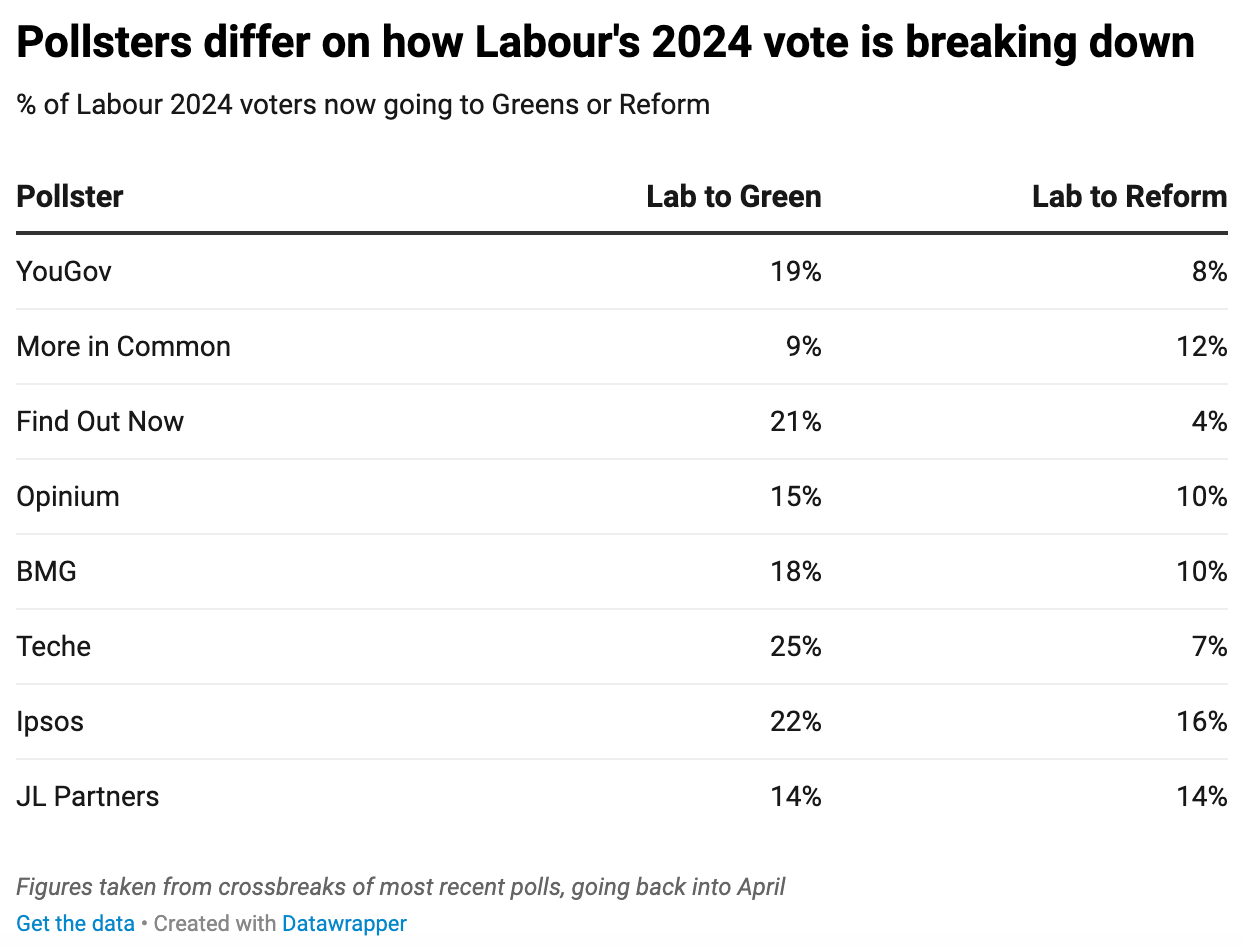
The 2026 Local election results can be used to help triangulate the polling evidence
Local election results cannot give us concrete conclusions about voter flows - do be deeply suspicious of anyone trying to sell you a story about individual voters using aggregate data:
People vote different in local versus national elections (which means there is no direct read across to national Westminster opinion polls even from exercises to extrapolate local election voting behaviour to national vote data, such as BBC’s Projected National Share)
Using swings from ward level data to directly extrapolate voter flows is an ecological fallacy (we don’t know who, if anyone, moved between parties when swings happen, just that the electorate in aggregate moved in that direction)
That said, we can use specific disaggregations of and trends in ward level results from 2026 to give us a clues as to which camp of pollsters is more likely to be correct about where the Labour 2024 vote is going.
In turn, this should have important consequences for our understanding of what Labour’s 2024 vote was, why they are behaving as they are, and how Labour should think about responding to that.
To that end, I think there are two particularly clear signals from the results data suggesting that Labour were struggling more versus the Greens than Reform. As I say, that alone does not give concrete conclusions about the flows of individual voters (which is what the polling is designed to do), but it gives some strong hints.
Labour suffered more where the Greens advanced strongest
During the overnight count in the small hours of Friday morning, John Curtice appeared on air to suggest that the ward level results suggested that Labour were losing out more to the Greens than they were to Reform. The evidence was quite clear on this when we looked at who was ‘suffering most’ when either the Greens or Reform were advancing strongest.
According to the data collected and analysed as part of the BBC’s Keyward exercise, Labour were dropping back on average by a whopping 37 percentage points in wards last contested in 2022 where the Greens were advancing most strongly in 2026 (up 30pts or more).
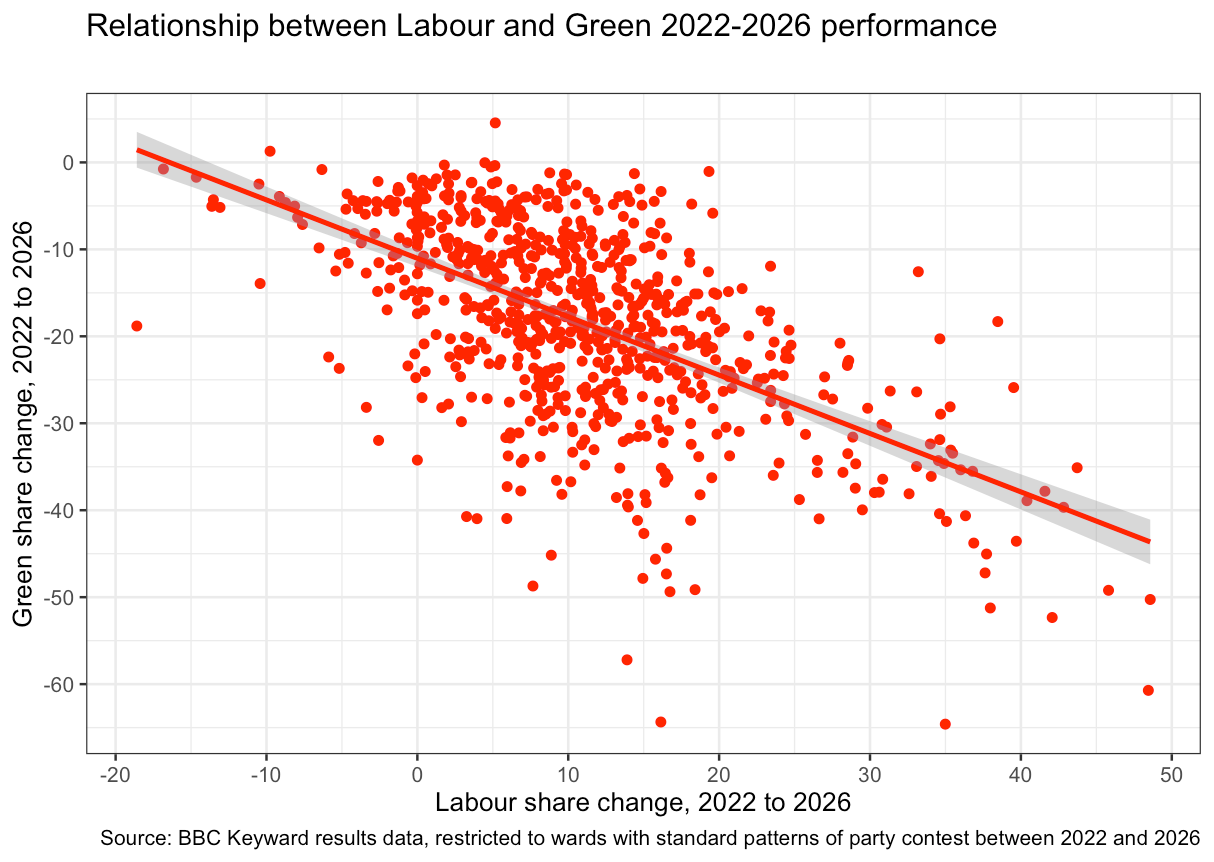
Conversely, Labour were down by much less than that, 20pts (which is still an awful lot, by the way), where Reform were up by 30pts or more versus 2022.
The relationship becomes even clearer when we look at the other side of the respective scales. Where the Greens were advancing least (by only up to 10-points or less), Labour were only down by an average of 12pts versus 2022. But they were still down by an average of 20pts where Reform were advancing by only up to 10% or under - making the relationship on that side of the coin completely flat.
Or, in other words, there is little to no statistical relationship between Reform performance and Labour performance, but a very strong (negative) relationship between Labour and Green performance.
Relatedly, the Conservatives were down by 26pts on their own high water mark in wards contested last in 2021 where Reform advanced by 30pts or more. Those ‘vaccine bounce’ elections were part of a very strong year of polling and electoral results for the Tories, against which they fell back heavily this time around. Labour for their part were down by just 13pts in such wards.
The more Labour vote there was to go around, the better the Greens did
We can also see similar relationships when looking at areas of particularly high Labour ‘prior strength’ in 2022.
Labour, like the Conservatives at the 2024 General Election, fell back more where they started stronger, as we can see from the table below. There is then a linear increase in the Green average performance as we move through the categories of Labour past vote, and an almost linear decrease in Reform performance. By the time we get to Labour’s strongest seats, the Greens have overtaken Reform in terms of mean growth in vote share.
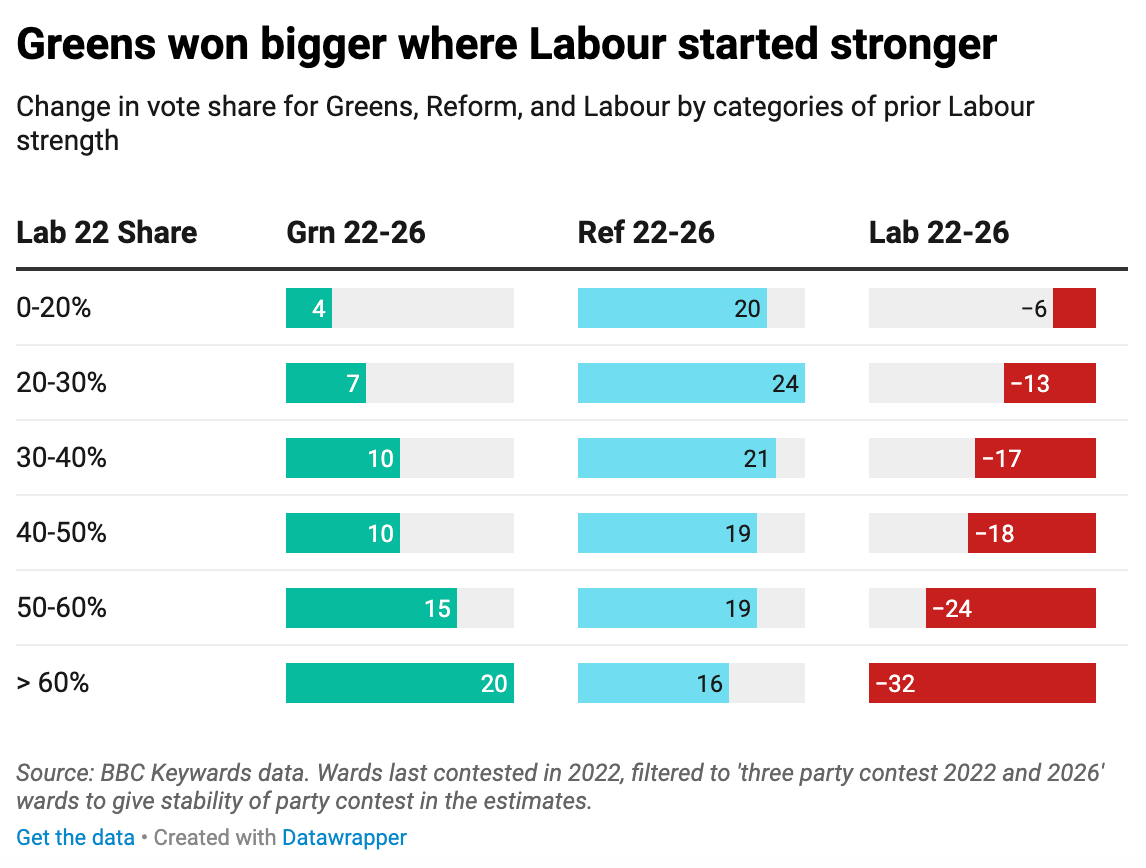
In fact, the ‘flip’ between Greens advancing faster than Reform happens at a Labour 2022 baseline share of around 55%. This sounds high, but as a category actually includes around half the seats Labour were defending this cycle.
Furthermore (see also below), this category of seat is particularly useful for analysing what happens to the Labour vote, because there is, quite simply, more of it to analyse (and it will constitute a larger chunk of whatever is moving).
It is worth noting that even at their ‘lowest’ level of advance, in those strongest Labour seats, Reform were still putting on 16 points relative to 2022. And they were undoubtedly doing so while taking Labour votes. However, it does not appear that they were doing so to the same rate as the Greens.
The Conservatives were also down (from a low baseline) by around 7 points in such wards.
Conclusion: #LE2026 data suggests the Greens are a bigger threat to Labour’s vote than Reform
Overall, we can pretty reasonably conclude from the election results data and the polling evidence that the Greens are a bigger threat to the Labour vote than Reform are.
Now, this can only really said in aggregate and general terms - there will be sub-groups of voters, and specific places, where the opposite is undoubtedly true.
And I’m sure some of my polling colleagues will still disagree!
It is also true and worth considering that this cycle of English local authority elections included many places where the Green vote ought to be strongest, such as the aforementioned large cities (including London).
However, that actually makes these sets of local elections better rather than worse to do this sort of analysis on, because such areas include a far larger chunk of Labour’s 2024 voters for us to analyse than other cycles (such as last year, where contests were fought predominantly in areas which included far more Conservative and Reform voters).
(This set of locals also ironically did not include any areas where the Greens won MPs in 2024, but did include elections in all but one council area where Reform won a constituency in 2024).
I’m not going to take a position on whether the data and conclusions presented here should prompt Labour to “move to the left”, or the opposite, or chase one particular set or voters or another in response to what happened on Thursday - not least because I argued against seeing Labour’s dilemma in those terms in my previous Substack.
That’s for others to consider and work out.
But I do think it’s quite clear from the results data, the result in Wales with Plaid storming to victory and replacing Labour there, the bulk of the polling evidence, and indeed even from what happened in Gorton and Denton earlier this year, what is currently happening to Labour’s fragile 2024 voter coalition. And that feels as if it ought to be relevant to what Labour does next.
The era of catch-all parties is over in the U.K. In many ways, Farage’s greatest gift to our democracy has been to finally usher in European style politics (for good and ill), with all that entails; bar U.K.-wide PR. If Starmer wants to really change our politics he should finish off Blair’s project and bring PR to all parts of the country.
I thought it was obvious, Greens take votes from Labour, Reform take votes from Tories. Reform is the new Tory party and Green seems similar to the way Labour was 50 years ago. Even though I do very much admire Polanski methods